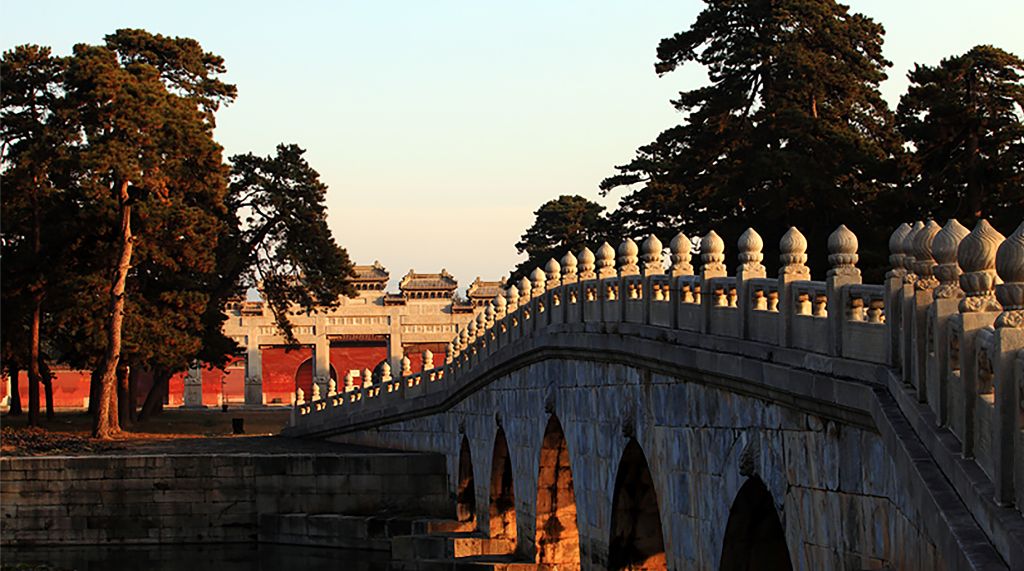
Western Qing Tombs, Hebei province
Introduction
The Western Qing Tombs are located at the foot of Yongning Mountain in Yixian county, Hebei province, approximately 98 kilometers southwest of Beijing. It is the final imperial tomb complex of the Qing Dynasty (1644-1911). Completed in 1915, the tombs were under construction for 185 years and consist of 14 tombs where four emperors, nine empresses, 57 imperial concubines, and 10 other members of the imperial family are buried.
Covering an area of 83 square kilometers, the Western Qing Tombs include the 14 imperial tombs as well as various other structures, such as the imperial auxiliary palace, the Yongfu Temple (used for imperial ancestral worship), barracks, and government offices.
As the largest and best-preserved ancient imperial tomb complex, it features the most complete set of architectural styles from the Qing Dynasty. The site was opened to the public in 1979 and was inscribed on UNESCO's World Heritage List in 2000.
Constructed according to ancient Chinese Feng Shui principles, the tombs are set in a landscape embraced by mountains and the Yishui River. These magnificent ancient buildings are surrounded by a grove of aged pines and cypresses, presenting a splendid and elegant view.
The tombs themselves hold great historical and artistic value. For example, the Tailing Tomb of Emperor Yongzheng (r. 1723-35) is notable for its group of three massive stone gateways (paifang), which symbolize dignity and supremacy and are arranged in a unique layout.
Each gateway is beautifully carved. Other notable structures include the Longen Hall at the tomb of Emperor Jiaqing (r. 1796-1820), known as Changling, which features a stone brick floor with striking natural striation and veining; the Chongling Tomb of Emperor Guangxu (r. 1875-1908), renowned for its durable timbers and its "bronze beams and iron pillars"; and the Changxi Tomb of Empress Xiaohe Rui, which boasts the only echo wall and echo stone among ancient Chinese tombs. The Yongfu Temple and the imperial auxiliary palace are the only remaining auxiliary structures from the Qing Dynasty imperial tombs.
The Western Qing Tombs also benefit from an ideal natural environment, featuring the largest artificial pine forest in China and the North Yishui River with its 17 tributaries. As a result, the area is known as a natural "oxygen bar," offering great potential for recreation and healthcare.
Address: Yixian county, Baoding, Hebei province Opening Hours: April 1 - Oct 31: 8:00 am - 5:30 pm Nov 1 - March 31: 8:30 am - 5:00 pm
Ticket Price: April 1 - Oct 31: 108 yuan ($15.45)/person (valid for two days) Nov 1 - March 31: 80 yuan/person (valid for two days)
Notes:
Visitors can purchase a ticket for admittance to one of the spots after 14:00.
- Free entry for children under 120 cm, soldiers on active duty, retired veterans, people with disabilities, individuals over 70, and voluntary unpaid blood donors (with valid certification).
- Students and individuals aged 60-69 can enter at half price (with valid certification).
Photo Gallery(2 pictures)CategoriesTourismTagResort TourismWorld HeritageCatalogue1. Introduction-
- []








